
AI is gaining ground in the field of eye screening
Artificial intelligence (AI) is now emerging as a key driver of transformation in ophthalmology. Faced with the rise in chronic conditions such as diabetic retinopathy, glaucoma and age-related macular degeneration (AMD), healthcare systems must address a twofold challenge: improving early detection whilst optimising medical resources.
Two recent scientific meta-analyses corroborate this trend. They show that artificial intelligence solutions applied to the analysis of retinal images achieve high levels of performance, comparable to those of human experts, whilst enabling large-scale deployment. This capability is particularly relevant in developing countries and resource-poor areas, where access to specialists remains limited.
This research highlights the growing role of artificial intelligence in improving the screening of retinal conditions, both in terms of organisational efficiency and patient adherence to care pathways.
As illustrated by the following findings from recent systematic reviews and meta-analyses published on PubMed:
Strategies for screening for diabetic retinopathy in developing countries (ID 41142633)
« These findings confirm the potential of AI-assisted screening for diabetic retinopathy in resource-limited settings and highlight the complementary roles of portable imaging and the delegation of tasks to trained non-specialists.»
Artificial intelligence improves attendance rates at follow-up appointments for retinal assessments in people with diabetes (ID 40447778)
« This systematic review and meta-analysis suggests that the use of an initial AI-based algorithm for the screening of diabetic retinopathy is associated with an increase in the use of follow-up examinations. This is most likely due to the immediate availability of results obtained using AI-based algorithms, in contrast to the delay in assessment observed with human assessors.»
In this context, OphtAI stands out as one of the most efficient AI systems in the world.
The scientific contribution of AI in ophthalmologylmologie
These two meta-analyses highlight several key findings for clinical practice:
- high sensitivity and specificity in the detection of retinal conditions, particularly diabetic retinopathy,
- the ability to standardise image interpretation, thereby reducing inter-observer variability,
- proven effectiveness in large-scale screening programmes, particularly in resource-limited settings,
- a key role in prioritising at-risk patients, enabling better organisation of care pathways.
These findings confirm that AI is no longer an emerging concept, but rather a scientifically validated technology, ready to be integrated into everyday practice.
OphtAI has met these requirements with:
- results that outperform industry benchmarks or relevant research, and performance on a par with expert human readers, whether in diabetic retinopathy, glaucoma or AMD,
- the ability to provide consistent and detailed feedback enabling the user to understand the result through data such as predictive values obtained by comparison with reference populations and heat maps,
- constantly improved interfaces and reports for healthcare professionals,
- guidance on patient prioritisation,
- guidance on management based on recommendations from professional societies.
These meta-analyses also emphasise a key point: AI does not replace clinicians; it enhances their capabilities.
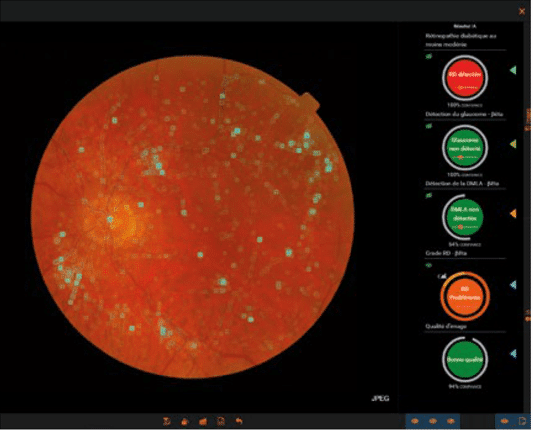
The combination of human expertise and algorithmic analysis enables:
- to reduce the risk of error,
- to identify weak or early warning signs,
- to improve clinical decision-making.
A response to the organisational challenges on the ground
Beyond diagnostic performance, scientific studies also highlight the organisational impact of AI, which is evident in the OphtAI solution in:
- an automated initial review of images,
- sorting of cases by urgency, making prioritisation easier,
- significant time savings for medical staff by reducing repetitive tasks.
That is precisely the benefit of being able to integrate a service like OphtAI into the IT tools used for patient care. In this case, the service launches automatically, without the user having to do anything.
Given the current strain on medical resources, this optimisation is essential. It enables specialists to focus on activities with higher added value, such as identifying complex cases and providing clinical care, whilst ensuring widespread and safe screening.
This approach is part of a responsible vision of innovation: AI that supports both healthcare professionals and patients.

OphtAI’s aim is to make artificial intelligence accessible, widely accepted and used on a large scale in order to improve the screening for eye conditions.

A catalyst for large-scale screening
It is important to integrate AI into public health strategies in order to regulate its use; this is why OphtAI is working with the french Haute Autorité de Santé and the french national healthcare insurance system.
By enabling rapid, standardised and accessible screening, it paves the way for large-scale campaigns, particularly for at-risk populations.
OphtAI fully addresses this challenge:
- can be deployed in a variety of settings (healthcare facilities, private practices, teleophthalmology),
- compatible with basic infrastructure (slow internet connection).
This ability to make screening more widely accessible is a major asset in the fight against preventable blindness.
A solution that complies with regulatory and safety requirements
In an increasingly regulated environment, the reliability of medical devices is essential.
OphtAI fits into this framework as a medical device certified by the CE and Health Canada (Class IIa).
The environments supporting the solution are certified for Health Data Hosting (HDS), and the software design complies with security, traceability and data protection requirements, with data processed in accordance with the GDPR, ensuring secure use for both professionals and patients.
We have also anticipated compliance with the European AI Act.
Towards AI-enhanced ophthalmology
The scientific literature therefore confirms that artificial intelligence is now not only an effective and relevant tool but is also set to become an indispensable part of ophthalmological practice, just like the imaging devices from which it draws its data.
OphtAI enables ophthalmologists to take a further step forward in adopting this technology by making it:
- accessible,
- easy to use,
- suitable for use in everyday practice without any complications.
By making screening easier, optimising the organisation of care and improving diagnostic accuracy, OphtAI is helping to build a more preventive, efficient and equitable field of ophthalmology.